Long QT Syndrome channelopathies


Diagnostic criteria:

≤1 pt: low probability

2-3 pts: intermediate probability

≥4 pts: high probability

Criterion Points
ECG findings:
>QTc:
 
>= 480 ms
3
460-470 ms
2
450 ms (men)
2
torsades de pointes
2
Twave alternans
1
notched T wave in 3 leads
1
Low heart rate for age (resting HR below 2nd percentile for age
0.5
Clinical history:
Syncope
With stress
2
Without stress
1
Congenital deafness
0.5
Family history
Family members with definite LQTS
1
Unexplained SCD at age 30 yrs among immediate family members
0.5
Notes::
  1. ECG findings should be obtained in patiens without medications or other disorders known to affect the QT interval
  2. Torsades de pointes and syncope are mutually exclusive criteria
  3. The same family member cannot be used for both Family History criteria
  4. QTc should be calculated using Bazett's formula


Genes and Channels

LQTS type Chromosome Gene Protein Ion current Triggers Notes
1
11p15.5 KCNQ1 KvLQT1 (Kv7.1) IKs exercise (swimming), emotion
  • Also SQTS2
  • Autosomal recessive, homozygous = Jervell and Lange-Nielsen Type I with congenital deafness
  • Broad-based T wave
  • Best response rate to ß blockers (>95%)
2
7q35-36 KCNH2 HERG (Kv11.1) IKr rest, emotion, exercise (acousting, post-partum)
  • Also SQTS1
  • Low amplitude/notched T wave
  • Lower response rate to ß blockers (>70%)(worsen bradycardia and thereby increase ventricular arrhythmias)
3
3p24-21 SCN5A Nav15 INa rest, sleep, emotion
  • Late appearing T wave
  • Response to ß blockers uncertain
  • Possible therapeutic response to mexiletine
  • Na blockers (lidocaine, mexiletine) can help 2:1 AV block by shortening ventricular repolarization, as block is due to prolonged ventricular refractoriness causing His-Vent block)
  • Other syndromes:
    1. idiopathic VF
    2. Brugada Syndrome
    3. conduction system disease
4
4q24-27 ANK2 Ankyrin-B INa, INa-Ca, INa-K exercise  
5
21q22 KCNE1 MinK IKs exercise, emotion
  • Jervell and Lange-Nielsen Type II with congenital deafness (milder phenotype than JLNS Type I)
6
21q22 KCNE2 MRP1 IKr rest, exercise  
7
17q23 KCNJ2 Kir2.1 IK1 rest, exercise
  • Also SQTS3
  • Mild QT prolongation with prominent U wave
  • Anderson-Tawil Syndrome (ATS1): K-sensitive periodic paralysis, frequent ventricular arrhythmias, dysmorphic features (short stature, broad nasal root, palate defects, hypertelorism), conduction system disease with LBBB, RBBB, PQ prolongation
8
12p13.3 CACNA1C CAV1.2 KCa exercise, emotion
  • Also SQTS4
  • Timothy Syndrome: 2:1 AV block due to delayed ventricular repolarization, Twave alternans, PMVT, TdP, organ system defects (heart [PDA, PFO, VST, TOF], skin, eyes, teeth, immune system, brain, dysmorphism such as syndactaly), episodic hypoglycemia (can trigger arrhythmias)
  • Prognosis very poor. Can be treated with Ca blockers, but ICD best treatment.
  • Also associated with Ca channels:
    1. Brugada Syndrome
    2. catecholaminergic PMVT
    3. ARVC
9
3p25.3 CAV3 Caveolin-3 INa non-exertional, sleep  
10
11q23.3 SCN4B NaVß4 INa exercise, post-partum
  • 2:1 AV block
N/A
10p15.5 CACNB2b CAVß2b ICa  
  • SQTS5


Risk Stratification

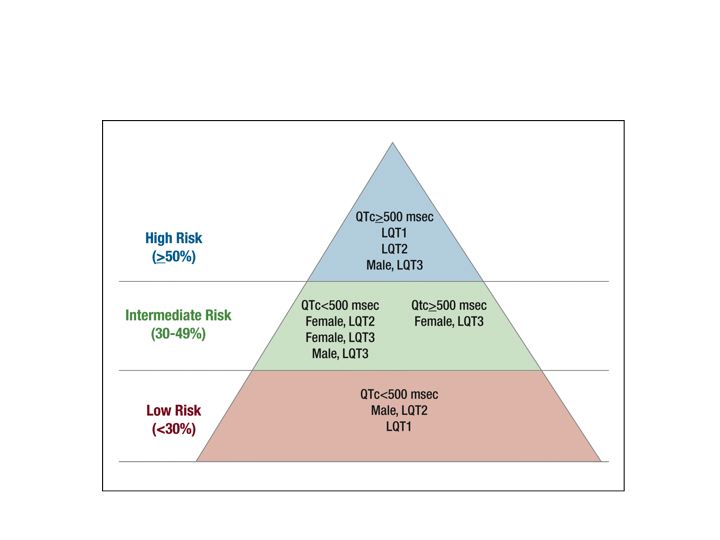
LQTS Risk Pyramid

lqts risk pyramid